Train for strength and muscle with the body you’ve got.
Bedrock Body Basics is a 12-week bodyweight programme you complete at home, in two sessions a week, with household items. Start with the free Bedrock Strength Check: five assessments in one session, gathering your own numbers.
THE FREE STRENGTH CHECK
You’ve always had a light build. Maybe you tried the gym, but didn’t know what you were doing, or felt out-of-place so you didn’t go back.
Then kids came along. You want to keep up with them, and set an example of strength and fitness.
But a young family brings less sleep, and less time and money for a gym. So it’s easy to assume you’ll have to settle for your frame as it is – at least for the next 20 years!
But your size doesn’t tell you what your body can do. You can find that out with Bedrock’s free Strength Check: five assessments done at home, in one session.
- 00KG
 Weigh in
- 01SECONDS
 Hollow Hold
- 02REPS
 Squat
- 03REPS
 Door Row
- 04REPS
 Push-Up
- 05PACES
 Bear Crawl
You finish the Strength Check with five numbers and your body weight beside them. Four of the numbers set the Levels you’d start building strength with in Body Basics.
The Strength Check and the programme are for men and women aged 18 to 50 who are able to train.
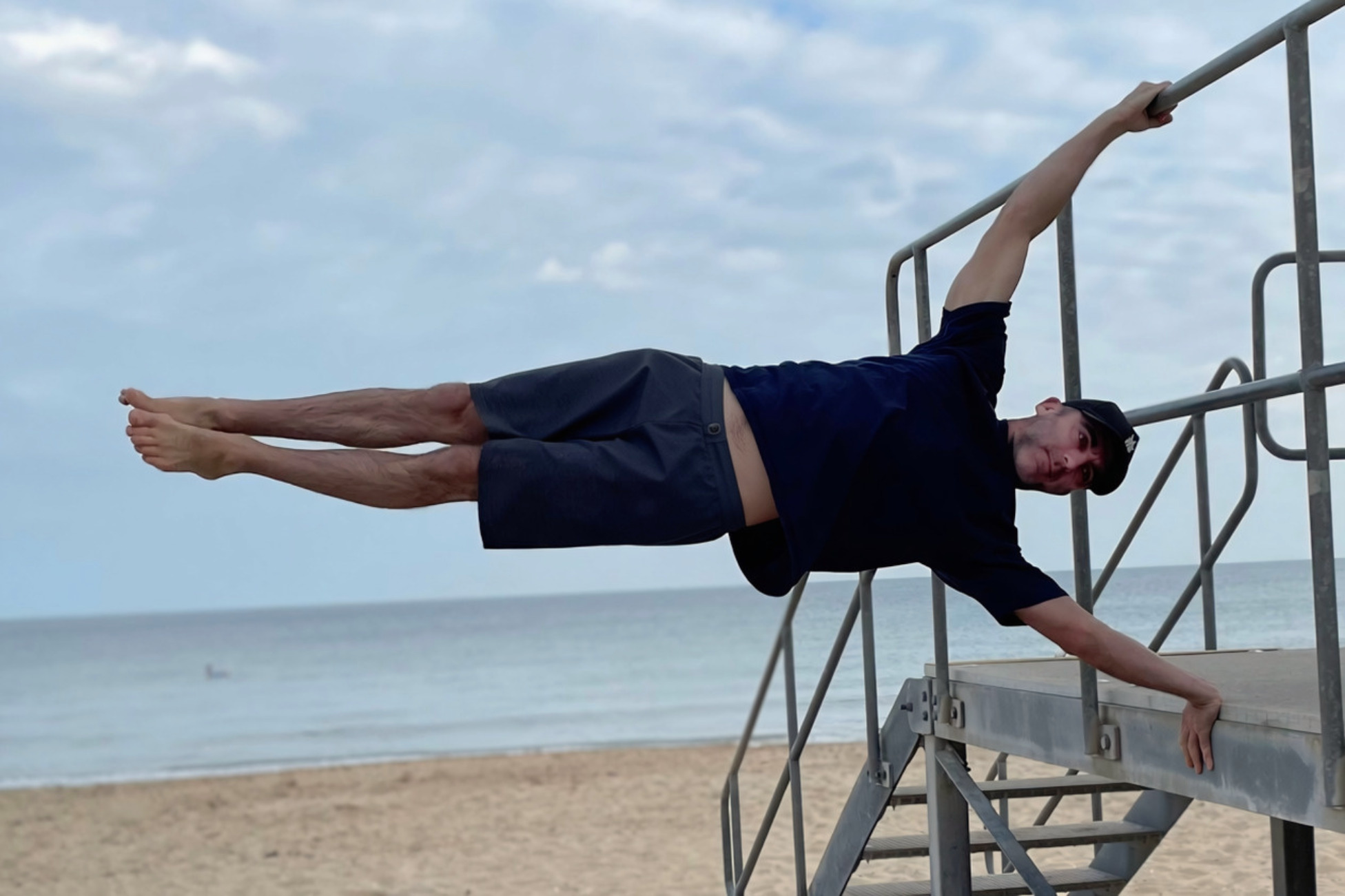
15 years ago, I had a light frame too. I still do, but it can do far more.
In my early twenties I was skinny, with very little muscle. I was fed up and wanted to get bigger and stronger. I wanted to be fit and strong for the kids I hoped to have one day. So, with an admiration for gymnastics and no spare cash for the gym, I started training with my own body weight and I’ve specialised in it for over 15 years now, with the occasional attempt at giving the gym another chance.
Today I’m stronger, and carry more muscle than I did at 23. That’s 15 years of my own training, mind, not a forecast for your next 12 weeks.
But here’s what I’ve come to believe from my experience in bodyweight training: most people never find out what their body can do on its own, because they reach for equipment before they reach for themselves.
The Body Basics programme works with you. You start where you are, with what you’ve already got, and you keep going.
It shows you how to train with your own body. First it measures where you are now, then it tells you exactly what to do next.
Nick
Can bodyweight build muscle?
Muscle grows from hard effort, whether the weight is heavy or light, and keeps growing as the work gets harder. With a barbell, you make the work harder by adding weight (load). With your body, you make it harder by changing position. For example, with push-ups: hands on a hip-height surface, then on the floor, then with your feet on a hip-height surface. Each step puts more of your weight through your arms. In bodyweight training, the position is the load.


In Body Basics, your Week 0 Assessment scores set the version of each movement you train for all 12 weeks. These versions are called Levels. The number of times you do a movement in a row (repetitions, or “reps”) then rises on a fixed schedule, from three rounds (sets) of three reps to five sets of 15.
This principle is supported by published research. For example, in a study of 18 young men over eight weeks, push-ups set to a matched load increased chest and triceps muscle thickness comparably to the bench press. And a review of studies found muscle growth was similar with light and heavy loads – when sets were taken to failure.
It’s one of 12 principles Body Basics is built on, one for each week. Some are shared principles of training, such as making the work gradually harder, which the American College of Sports Medicine recommends in its 2026 guidance. Others are Bedrock’s own, such as “the position is the load”, and follow from how bodyweight movements work. The app labels each one, so you always know which is which.
What Body Basics cannot claim is a certain result by a fixed date. Bodies respond at different rates. That’s why you re-assess at Weeks 6 and 12, weigh yourself the same day, and compare only with yourself.
Kikuchi N, Nakazato K. J Exerc Sci Fit 2017;15(1):37–42. Schoenfeld BJ et al. J Strength Cond Res 2017;31(12):3508–3523. Currier BS et al. Med Sci Sports Exerc 2026;58(4):851–872.
12 weeks, one next step at a time.
- WEEK 0
Weigh in and do the five assessments. If your Strength Check scorecard is dated within the last 30 days, its weight and scores are your Week 0, with no need to repeat the assessments.
- YOUR LEVELS
Each score sets the version of squat, pull, push and Work Capacity* you train for all 12 weeks. A Level names a version of a movement, not you.
- 24 SESSIONS
Two a week, on two days you specify. They include: warm-up, squat, pull, push, and Work Capacity. Weeks 11 and 12 drop Work Capacity. Week 1 is deliberately light to help your body acclimatise to the movements, and the volume rises from there.
- WEEKS 6 AND 12
Weigh in again and repeat the five assessments on the same day. You see what’s changed as numbers, compared only with your own Week 0.

If a session falls through or doesn’t happen on a day you’ve specified in advance, do it in the next free slot. You don’t have to wait for next week.
*Work Capacity: the total amount of training you can perform, recover from and positively adapt to.
What you get today.
Your app
All 24 sessions, set to your own Levels, with the five assessments, timers, your log and your scorecard. You build your own version of it on your phone in five easy steps, once it’s unlocked with the licence key in your receipt. One key unlocks up to two phones, so a new phone doesn’t need a new key. Your training data is yours alone and stays on your phone: save a backup file in the app to carry it across.
20 videos
The warm-up, the Assessments Warm-Up, the door set-up, the five assessments and all 12 exercises. They play in the app.
Weekly emails
A short email each week with that week’s sessions and one training principle, plus reminders for the Week 6 and Week 12 re-assessments.

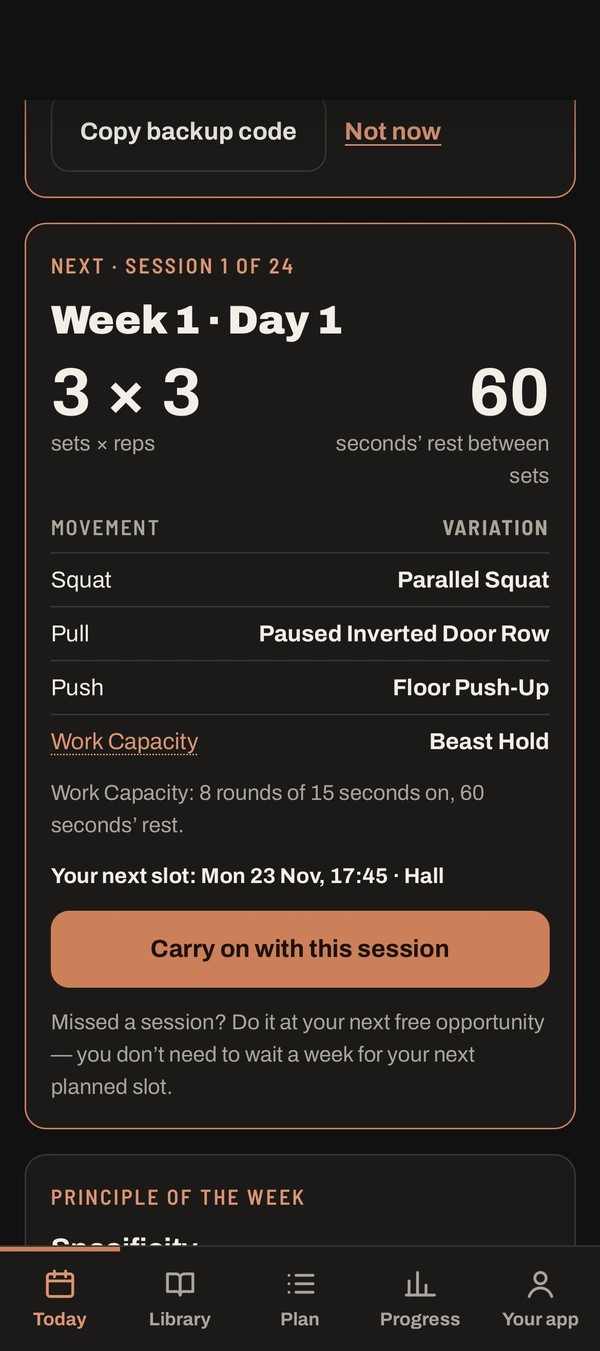
[Screenshot: your scores at Weeks 0, 6 and 12, with your body weight]
What you need: household items only.
- A sturdy door that opens away from you
- A double bedsheet
- A tennis, or similar-sized soft ball
- A box or chair that puts your thighs roughly parallel to the floor when you sit
- A sturdy hip-height surface
- Bathroom scales or a set you can get to
- Your phone
Bedrock Body Basics
The programme isn’t open yet. Get the free Strength Check and we’ll email you when it opens.
For men and women aged 18 to 50 who are able to train. Before you buy, answer the five readiness questions in the FAQ below.
Get the free Strength CheckFAQ
How long is a session?
About 45 minutes in Week 1, rising to about 60 minutes by Week 12 as the sets and reps increase.
I’ve started programmes before and stopped. What’s different here?
You never decide what to do. The app shows the next session, the version of each movement, and the sets and reps, so you can save your decisions for work or home, like whether you’ll agree to your three-year-old changing her outfit for the 20th time today! You choose your two training days and where you’ll train on each, and you can change them whenever your week changes. At Weeks 6 and 12 you repeat the five assessments and see your numbers beside your own Week 0. That doesn’t guarantee you’ll keep going, but it removes the guesswork.
I can’t do a push-up yet. Can I still start?
Yes. The push-up assessment counts floor push-ups, and zero is a valid score. Any score from 0 to 5 starts you on Level 1: push-ups with your hands on a hip-height surface.
What do I need?
Household items only: a sturdy door, a double bedsheet, a tennis, or similar-sized soft ball, a box or chair, a sturdy hip-height surface, bathroom scales, and your phone.
Do I need to change what I eat?
Training gives your muscles a reason to grow; food supplies them with the fuel they need to do it. If you find it hard to put on weight, how much you eat matters too. Body Basics doesn’t include a nutrition plan. If you have a medical condition or specific dietary needs, speak to your GP or a registered dietitian.
Do I need to do the free Strength Check first?
No. The programme takes you through the same five assessments as Week 0. If your Strength Check scorecard is dated within the last 30 days, you can use its weight and scores instead.
How are the Levels set?
By your own score on each assessment, not by your age, sex or size. Published, trial-based standards don’t exist for most of these assessments, so the cut-offs are Bedrock’s judgement, checked against Strength Level’s public user data where comparable data exists.
Which phones does the app work on?
Opened on iPhone (Safari) or Android (Chrome) then added to your Home Screen. One licence key unlocks up to two phones, and your training data stays on your phone so it belongs to you.
Is it suitable for me?
It’s designed for men and women aged 18 to 50 who are able to train. Before you start, answer the five questions below. They aren’t a medical assessment and don’t replace advice from a doctor.
- 1Has a doctor ever said you have a heart condition, or that you should only do physical activity under medical supervision?
- 2Do you get chest pain at rest, or chest pain brought on by physical activity?
- 3Do you lose your balance from dizziness, or have you lost consciousness in the last 12 months?
- 4Do you have a bone, joint or soft-tissue problem that gets worse with activity?
- 5Are you currently being treated for high blood pressure, or any other condition where you have been advised to be careful with exertion?
If you answer yes to any of them, speak to your GP before starting. If you’re pregnant or have recently given birth, speak to your GP or midwife first. Stop any exercise that causes pain, dizziness or unusual breathlessness, and seek advice.
Can I cancel?
You normally have 14 days to cancel an online purchase. With digital content, that right ends once you get access, as long as you agreed to immediate access at checkout and confirmed you understand you’ll lose the right to cancel. The checkout asks you to do both before you pay.
Who’s behind Bedrock?
Just me, Nick. I’m a Level 2 qualified gym instructor, and I’ve trained with my own body weight for over 15 years. I wrote the programme, filmed the videos on my phone and built the app myself. When you email support@bedrockstrength.co.uk, I’m the one who replies.
Start with your own numbers.
The free Strength Check is one session at home. You’ll hear by email when the programme opens.
Keep going.